This past winter I wrote a short story set in Scotland. It is a bit dark, but here it is....
---------------------------
Dark Hamish Copyright 2008
By Erik Helm
It was in the late summer of 1957 that my fiancee Ann and I traveled to Scotland as a sort of pre-marriage honeymoon. Ann was interested in the unique Scottish scenery and as an artist, was looking forward to painting and sketching landscapes. I was going to see the land of my distant ancestors, and to fish for salmon on the Deveron River. The whole trip was to be inexpensive, as we had booked the steamship tickets second class, and received the fishing rights from a wealthy friend of my father’s as an early wedding present. Salmon fishing in Scotland is a sport of the wealthy, and in order to keep it that way both river access and fishing is controlled by clubs and associations. One can’t just go down to the river and fish, but instead must buy memberships or purchase time on the water. I would never have afforded it on my own without being given the fishing as a gift.
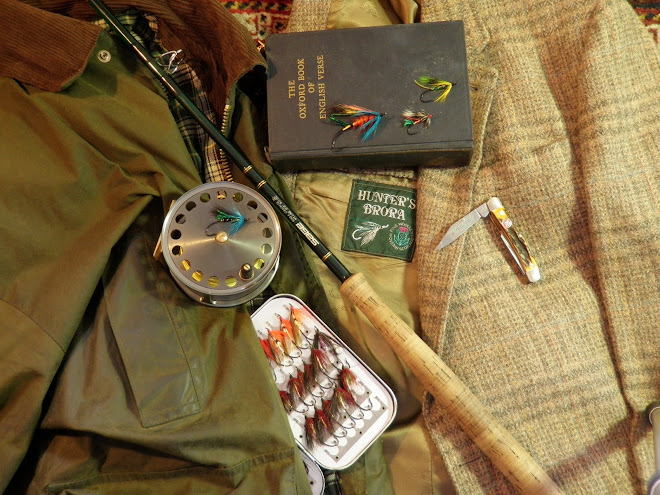
I had prepared for the trip by tying dozens of traditional salmon flies. An avid fly tier, I owned the books by Kelson and Pryce-Tannatt, and was captivated by the colors and curves of their salmon flies.
Arriving anxiously after the long sea voyage, Ann and I checked in to our lodgings near the town of Huntly; a public house called the “Black Bottle”. A charming stone and wood two-story building dating from Tudor times, it consisted of a darkly lit but comfortable pub and separate small dining area on the first floor, and three bedrooms on the second.
The first thing we noticed when we entered the pub was the warmth of the fire, which both provided much of the illumination, and beckoned the chilled traveler to sit awhile and enjoy a pint of ale. It may still have been late summer, but the unpredictable damp Scottish weather could turn downright chilly. The barroom had long tables and benches that were heavy and made of oak. They were darkened with the smoke of the fire, spilled porter, and the sweat of the travelers and locals who found solace hunched over their pints.
The walls were of beam and stucco and seemed as old as the hills. The décor was sparse, consisting of mostly old faded pictures of local scenery, portraits of famous Scotsmen cut from books, and a few tantalizing photos of anglers dressed in tweeds and holding their proud catches. Several rusted pieces of armor dating from the period of the English Civil War hung behind the bar itself. One I recognized as an excellent example of a lobster-pot helmet.
The rear of the bar consisted of small casks of spirits, and various bottles. Centered over the bar was the namesake for the pub, a leather flask or bottle of prodigious size dating from the late medieval period.
On the whole I found the pub itself to be rustic and charming. As a graduate student in history, I preferred local color to any mass appeal hotel anyway, and the description given by my father’s friend in his recommendation of the Inn did it justice. Ann turned to me smiling, and indicated her approval.
The innkeeper and pub owner, a ruddy faced and portly man with a thick red beard, who introduced himself only as ‘Bob’, showed us up the creaking staircase to our room. He explained that the hostess ‘Mary’ was in town at market and would be back shortly to see to our needs.
In contrast to the dim and dark pub, the second floor was clean and well lit. Our room was small, (Ann, always the optimist, called it cozy), and featured a wood framed feather bed and a view encompassing the immediate countryside, and on the horizon, the Deveron. Ann was thrilled with the scenery, and couldn’t wait to set up her little portable easel and watercolors. It may have been only 4 p.m., but we were very tired from the long bumpy bus-ride to the Inn, and instead of sallying forth we just collapsed into the featherbed.
The next morning’s sun had barely began to burn off the moist fog when we were awakened by Mary bearing a large bowl of hot water and several snowy white towels that she set on the large dresser in our room. This apparently was the Scottish equivalent of the morning toilet. I turned to Ann, and she smiled back with a comical grin as if to say “when in Rome…”
We broke our fast in a little room adjoining the lower level pub. Ann and I were seated at a small table and served a traditional breakfast of thick porridge, black pudding and eggs, and scones with strong black tea. It was quite delicious especially since we were famished, and was filling enough to last a farmer the entire day.
We had set aside the first day to see the sights in the immediate area, which was broadly known as the ‘Strathbogie’. A river plane, it consisted of wide grassy fields surrounded by wooded hedges with tall regal hills rising in the distance. Everywhere the air was fresh, with a hint of dew and the smell of the river, still in the distance. Ann found a field of wildflowers at the base of a small hill surrounded by hedges and set up her painting materials. Promising to meet her in time to lunch on the cold beef and rolls which we had received as a pack-lunch, I strolled off in search of the river.
As I started to get closer to the Deveron, the terrain became more rock-strewn and sloped downward, covered everywhere with tiny flowers, tufts of grass, and lichens. The free flowing river was smaller than I imagined, but large enough that covering a salmon pool required a goodly cast.
I sat on the bank and listened to the water growl and murmur. I was simply overjoyed to be in Scotland at last.
Below me and down river some distance I observed several gentlemen standing on the bank at the edge of the water slowly swinging what appeared to be thin medieval lances back and forth. These would be the ‘spey’ rods I had read so much about. A smallish figure scurried between them, and I instinctively knew that he must be the ghillie. After slowly working their way downstream, they rounded a corner and were lost to view.
I wandered the riverbank for a while traveling in an upriver direction, alternately peering into the water, or watching birds.
Excited at the prospect of fishing a beat of river that must not be far from this idyllic area, I lost track of time, and had to hurry back to the waiting Ann and our picnic lunch. She was in no rush either as she had the beginnings of a beautiful watercolor, which if I may say in my biased opinion, paid perfect tribute to the Scottish countryside. Ann was becoming quite the artist.
After our repast I surprised her with a bottle of champagne I had concealed. We toasted the scenery, the gift of the beautiful day, and finally each other as we drank in both the wine and the equally intoxicating air. Getting a bit snoozy, we stretched out on a blanket we brought and took a pleasant nap under the Scottish sky.
Waking in each other’s arms, we realized it was time to return to the inn if we were to make dinner. The brisk walk through the countryside refreshed us, and I for one was looking forward to supper.
After a short trip to our room for a wash up and a partial change of clothes, Mary once again seated us at a table in the small dining area. There was only one other couple having supper, and we exchanged pleasantries consisting mostly of nods and smiles, as the couple appeared to be Dutch, and spoke very little English.
For supper we were served thick soup of barley and vegetables topped with a thick slice of Angus beef and flowery potatoes. To wash down the meal, a large pot of black tea was provided. Ann and I were enchanted with the meal and the rustic atmosphere and we agreed that we could get used to this!
Feeling full but invigorated, we adjourned to the pub room to partake of the local potables.
The pub was slowly filling with the local characters, and Ann and I were having a ball people watching. Several farmers sat at a table over their pints, looking like a picture out of time, their short pipes slowly adding to the atmosphere of the room as they held an entire conversation made up of short grunts, and replies of “Aye….” Their tweed caps were pulled low over their eyes, and they gave off a sweet scent of the barnyard.
We tried the local porter and two of the various ales that were all delicious, tasting earthy and full-bodied. Bob then recommended that we try a “Wee Heavy”, which was an ale intoxicating in it’s full-bodied richness.
By now other patrons had arrived and were pulling on their pints while discussing the weather, muttering over dominoes, or discussing the abstractions of local sports.
A tall and distinguished looking local who seemed affluent judging from his bespoke jacket and breeks, stood very erect and proper at the bar itself conversing softly with Bob.
It dawned on me suddenly that the only female present in the pub, other than Mary the serving girl, was Ann. In America she would have been the center of attention, but here in Scotland, she attracted only a quaint smile and a polite tipping of a cap.
I was at the bar ordering us a nightcap of the local Scotch whisky when I noticed a lone figure seated in a dark corner. He was large and wild looking with a massive head of black curly hair that spilled out from under a dirty cap. He wore a coat of indeterminate color, which was buttoned crookedly, and was hunched over his pint of ale, slowly manipulating something in his hands. His eyes were fairly hidden by his thick and unruly eyebrows, but I could tell they were bloodshot.
When Bob came back with the two rather large glasses of amber nectar, I motioned with my head to the lone stranger, curious to know more. Bob furrowed his brows, motioned me closer and whispered “ Tha’ is Dark Hamish, Ya’l nae git much ot’ a ‘im!”
“What do you mean?” I asked.
Bob motioned me over to the other end of the bar, and I followed. “Ee’s a wee daft begger, ee is. Ee’s Twa bubbles aff the centre.” I still looked puzzled and curious so Bob whispered to me “ Ee’s blootered most ‘a ‘da time, and as ‘ee tells it, ‘is Mudder is dead these wee years, and ‘is Fadder died in da war. ‘Ee lives in ‘is parents ‘ouse up on Nobbin hill, and done nae want for company udder den hisself!” Bob winked with a frown and went about his business.
It was hard to penetrate that brogue of his, but I certainly got the gist.
I was about to pick up the drinks and retire to our table when the tall gentleman smiled at me, and introduced himself as Alfred, an Englishman who several years before, charmed by the scenery, had retired to the Strathbogie area. He quickly told me a fuller story of the lone stranger.
It seems that Hamish was the once promising only child of proud parents. His Father was a colonel in the British army and was stationed in China and Burma during the war. He had died in the jungle in ‘44, his body never being recovered. His pension, in addition to other old moneys kept the wife well off. She was an elegant woman of extravagant tastes, and the large Edwardian home was decorated with exotic furnishings of the orient. People recalled that when the mother came to market she was always dressed in the best eastern silks, and bedecked with furs.
Hamish was a well liked but solitary figure that doted on his mother and cared for her during the long illness that finally claimed her. No one seemed to know exactly when she died, as there was no immediate family; both parents being only children as well.
It was after her death that Hamish began to slide to heavy drinking, and sank more and more into himself. He still resided at the old house, but both the home and Hamish now could be described as “a bit sodden and past it.”
Hamish kept himself in fish n’ chips and drink by selling the odd eastern curiosity sent home years ago by his father, and by tying flies for visiting salmon anglers.
Looking back at Hamish it seemed to all make sense. There he sat brooding and whispering to himself with red haunted eyes, lingering over his endless pint, and slowly tying salmon flies on what I now recognized as a thumb vise.
The locals obviously knew him and his habits, as there seemed to be a sort of circle of space around him that no one would invade. The only one I saw approach the table at all was Bob, silently bearing a fresh pint.
By this time, Ann was getting antsy with my absence, but as I returned and we sipped the Scotch, I told her of the story of Dark Hamish. She listened with wide eyes, completely absorbed with the sad tale.
After the scotch, we agreed that we were now quite tired, and that it was time to turn in as tomorrow would see the first day of my salmon fishing, and we would need to make an early start.
I must have been exhausted, because I never remember having gone to bed or even undressing, and the next thing I knew the dutiful Mary was awakening us. I arose with a foggy mind and a crimp in my back from some dubious position I must have sunk into in the feather bed, but Ann was well rested and teased me about my little snoring, which to my annoyance she laughingly described as a “choking songbird.”
I dressed in the clothing I had brought along for the purpose of the fly-fishing, corduroy pants, a tattersall shirt, and a Barbour oilskin jacket. Ann wore a beautiful long heather colored skirt and a white cable knit Irish sweater. As Americans, I hoped we would be dressed appropriately as this Scottish salmon fly-fishing was quite a tradition of noblemen and gentlemen, and the dress separated the classes as much as the money and titles did.
We arrived outside the Inn just in time to meet the van from the salmon association that would take us to the beat water I would fish. Seated in the van, Ann and I marveled at the beauty of the scenery as we traveled a rustic road paralleling the river.
We arrived at our destination a little before 9 a.m., and joined the group of anglers standing around a small hut at riverside. Ann set up her easel on the hill overlooking the river.
The anglers introduced themselves, and I was delighted to find that I was not the only rookie to Deveron salmon angling. Ian, a businessman from London who had to be in his late sixties had fished the river several times before, but Connor, a young Irishman in the shipping trade had only fished in his country. Both were dressed in traditional garb of tweed jackets, and both wore ties. I felt the under-dressed yank that I was.
We met our ghillie Angus, who would guide us through the days fishing. Angus was a serious looking lad, not more than a few years older than I was. We soon learned that he was the son of a famous ghillie who had served on the river since the early 1900’s.
My equipment was provided to me as arranged by my father’s friend, and consisted of a fourteen foot cane rod and matching Perfect Reel built by Hardy. I almost feared using such an expensive outfit for fear of breaking it, but Angus assured me that in all his fathers’ years, only one rod had ever been broken, and that happened when an angler had fallen off an embankment. I promised him, tongue in cheek, to try “not to fall on my arse.”
The two handed or ‘Spey’ flyrod was new to me, and Angus coached us on it’s use, warning: “ye nae pull ‘da line from ‘da water sir”. All three of us practiced swinging the long rod slowly around and behind us, and roll-casting it forward. Angus, coaching us constantly, let us know after a half-hour that we were ready enough. I didn’t feel proficient at all, but was amazed at the way I could cover water with the long flyrod.
Connor was to share the upper pool in our allotted beat with another angler we hadn’t met yet, while Angus took Ian and me to the lower pool.
The water I was to fish was a beautiful curving stretch of river with gravel bottom, and containing several underwater boulders which produced tell-tale boils at the surface to let us know they were there. We would mostly be fishing from the bank, but in some areas would wade into the river a few feet. The pool was over three hundred yards long, so dividing it in half, Angus instructed Ian to take the lower stretch, while I would start at the riffle marking the top of the run.
Angus looked at the flies I had tied for the trip, and ignoring the thunder and lightnings and blue charms, he chose a smallish size 6 march brown tied on a Limerick bend hook, and tied it to the leader himself. He instructed me to cast the fly out over the water and follow the swinging fly with the rod as it made it’s way across the water to dangle beneath me. Then I was to step downstream and repeat the process. He watched my first cast, which was a bit clumsy, nodded his approval, and strutted off to Ian with the last instructions to “shout” if I felt anything happen to the fly, however tiny that might be.
I methodically cast and stepped my way down the run, jealous of Ian’s infinitely superior and graceful casting form that I could observe at will due to being behind him in the water. Neither of us received any pulls from fish in the lower pool, so we gathered back at the fishing hut for a short lunch.
Connor had caught a small grisle (a young yearling salmon) but that was all we had to show for the mornings fishing.
While eating our roast beef and drinking a charming Bordeaux I asked what fly Ian had been using. He kind of smiled and pulled over his rod to reveal a fly like nothing I have ever seen before. It was beautiful in its simplicity and yet rich with color. Its butt was of red wool preceded by a body spun of some natural rich brown fur. The hackle was tan and gray, but it was the wing that intrigued me. It shimmered with translucent colors that changed according to how the light hit them. It was without a doubt the most singularly unique fly that I had ever seen.
“What is it called?” I asked.
“It has no name that I know of,” said Ian.
“Where did it come from, I have never set eyes on anything like it?”
“A local lad ties them.” He replied. “ A sort of strange dark chap. Apparently this is the fly to fish on the Deveron, and the sneaky bastard charged me five pounds for this one fly!”
“No!” I exclaimed.
“Oh aye, he has his own methods for the body and the wing, and try as they might, the ghillies can’t duplicate it. It killed over forty salmon last year alone, often when nary another angler caught more than a chill!” “It’s the only fly I ever fish on this river.”
“But five pounds, for a single fly?”
“Oh aye, and he ties only a few per week, so he always has someone begging for one!”
Suddenly it dawned on me who had tied the fly.
“Is his name perchance Hamish?” I asked.
“Aye, that’s the bugger all right.” Ian scowled.
“The drunken fool would only sell me one of the bloody things, so I threatened the ghillie to tie a good knot, or else!” he remarked.
After our lunch we switched pools, and Ian and I walked to the upper run which was faster and more turbulent than the lower pool. This time I fished farther down, and Ian started at the top of the run.
On my very first cast a boil erupted where the fly was and Angus came running over with instructions to “do nothing, and don’t move!”
He quickly changed the fly to a smaller blue charm and instructed me to back up a few steps and cast again.
Despite two more changes of flies and a dozen casts, the salmon never appeared again, and I resumed my meditative casting and stepping. I couldn’t help feeling that this was my only chance for a salmon come and gone, and my heart sank at the thought.
Suddenly a shout came from upstream, followed by a loud rasping of a Hardy reel in distress. Ian had hooked a salmon!
I reeled in my line and ran after Angus to see the action from up close. The chrome colored salmon was jumping down the length of the pool, launching itself higher each time, and collapsing back into the water with a disturbance that sent bankside birds flying for cover.
Ian’s rod was bent with strain, but his face held an expression of pure joy. It seemed that he had suddenly become younger than his years, as if the salmon was his fountain of youth. Angus stood by with a large net, and whispered encouragement. To my disbelief, the line suddenly went slack, and Ian had a sick look on his face. “Bloody Hell!” he swore, “I lost her!”
“Aye,” said Angus, “and she took the fly too.”
Ian, who had turned red in the face, reeled up the line to disclose a leader devoid of fly.
“Well, I’m done” he said. “I only have confidence in that damn fly the daft bugger ties, and I don’t have another.”
Ian left the pool and walked back in the direction of the hut with shoulders bowed, leaving the water to me.
Despite doing all that Angus instructed, I never did catch a salmon that first day, but had a pleasant time nonetheless. I had read that salmon fishing can kind of be like that, and many an angler much more skilled than I was had gotten the ‘royal skunk’ for days on end before landing their first salmon. Ian had been lucky, or had it been the fly?
I began to wonder.
Angus and I walked back to the fishing hut, and met up with Ann who was being entertained by Irish stories that Connor was telling with flair. She showed me her completed painting, and I was surprised to see myself in the landscape, rod in hand. If nothing else I would always have the painting to remind me of the Deveron.
It was getting late as the van came along to take us back to the Inn. Ian would be riding with us as well, but would be dropped off a bit earlier than us as he was staying at the top hotel in the district.
Having regained his composure after losing his salmon, Ian surprised us by his knowledge of the countryside, and pointed out places of historical interest as he narrated the trip back with a running commentary. Not far from town, he pointed out a small church that had seen better years, and then lifted his finger to the hill beyond the church and remarked that there on the hill was the house where the “chap who ties the flies” lives.
Ann and I strained to see, but with the falling dusk could only make out a largish gray edifice near the pinnacle of the hill surrounded by trees and ill-kept scrub.
After dropping Ian off we arrived back at the ‘Black Bottle’ just in time to be seated in the dining area and enjoy a thick baked salmon fillet and salad for dinner. Neither Ann nor I felt tired, so we adjourned once more to the pub area. I had forgotten that today was a Friday, but it dawned upon me as I saw the pub already busy with a crowd of locals. Bob welcomed us, and after inquiring after the day’s fishing, treated us to two large amber concoctions he called ‘Highland Liquor’, which tasted like scotch and honey with a hint of lemon and fennel. Both of us felt the heat from the liquor go straight to our heads, and we sat back in our seats in a dreamy state. The warmth in the pub was welcome, for now the locals coming in were dripping with rain, and each time the door opened a misty fog rolled in. The famous Scottish weather had showed it’s fickle face at last.
After enjoying our way through the liquor and tasting two of the local scotches, both Ann and I were feeling a bit tipsy and were glowing inside. I went to the bar to order a couple of pints when I spotted Dark Hamish seated in his usual corner.
It must have been the whisky that gave me courage, but when I saw that he was immersed in tying one of his flies, I couldn’t help myself from going over to get a closer look.
Standing over Hamish I tried to peer closer through my goggle-eyes at what he was doing. As I looked I noticed a strong odor about him. It was not just the smell of someone who does not bathe, but something worse, like the smell of decay.
He obviously had a sixth sense dedicated to anyone getting too close and invading his private space, because he suddenly looked up and glowered at me while crossing his arms against his stomach to hide the work in progress. “Piss off!” he growled emphatically, his red eyes turned up to me with a fierce and malevolent glare.
Flushed with embarrassment and anger, I made my way back to our table.
I quickly explained to Ann what had transpired, as she had only witnessed the exchange from a distance. For some protective reason, she was angrier than I was about the whole thing. I had just wanted a peek at how the infamous and striking flies he tied were constructed. I certainly never meant to start an incident.
A long-time friend of Ann’s back home once warned me about my fiancee, stating that she was “passionate and impulsive.” Until that moment I didn’t recognize the full extent of the warning.
“I have an idea!” Ann sort of purred. “Let’s borrow the bicycles that the pub keeps for the tourists, and go up to his house.”
“Your mad!” I said.
“No, really, it’s only a mile or so, it would be easy.”
“Why in the world...”
“Because you know you want to.” “Besides, I know you well enough to be sure that you would do almost anything to get a look at that fly, you obsessive nut!”
“Not obsessive…. Just well, interested. Right?”
“Besides, it would be a blast to see how this guy lives; and… no one tells my future hubby to “piss off”.”
I realized at this point that I must be fairly drunk, as I still did not fully understand Ann’s idea, but with foggy eyes I made my way to the bar, gesturing for Bob and asked him for the loan of the two bicycles.
“ Y’er nae goun oot thar?, its rainin' auld wives and pipe staples.” Bob cried with concern. “Yeel catch a death, ‘sides y’er a bit blootered yeself.”
Despite Bob’s concerns, Ann and I donned our weatherproofs, grabbed the bikes from the former stable behind the pub, and warmed with liquor and giggling, tottered off unsteadily into the rain.
I was having a hard time keeping the bike on the road, as the old WWII vintage Huffy seemed to have a mind of it’s own.
I followed Ann as best I could with the rain fogging up my glasses, and kept begging her to slow down, to which she just shot back teasing giggles.
As we wobbled down the country road, I kept wondering about what the end game to this silliness would entail, and how we would be able to see anything anyway. By now cold and wet, I was beginning to regret going along with Ann’s craziness when she gave a little cry and pointed directly to our right where I could barely make out the silhouette of the old church.
“Let’s stash the bikes here, and sneak up to the house,” she said with a mischievous smile, her face dripping with rain. Sobered somewhat by the chill and wet, I lead the way past the church and up to the old house using its single dimly lit window as my guide.
The old house was large and squarely shaped, with two stories topped by a widow’s walk with collapsing iron railings. It possessed a forgotten charm tainted by neglect and decay. I kept tripping over unseen debris hidden in the long clumps of weeds inhabiting the yard, but slowly led Anne to the window that was barely illuminated from within.
It was full of dust, and so dirty that we could hardly see in. I could barely make out a crowded and messy table on which sat a single kerosene lamp that cast dark shadows about the room.
“Let’s try the door and see if it’s locked.” I said.
Ann looked less enthusiastic now than she did when starting out.
“Maybe we should just go back.” She whispered.
“Not on your life.” I replied. “You started this goofy idea, and now that we are out here and he is back inside the pub, we at least can have a little look-see.”
I made my way up to the porch, and slowly ascended the stairs, picking my way between the gaps and holes that had opened in the rotting wood, and avoiding the broken furniture which lay strewn about. While Ann waited below, I tried the door only to find it locked. Jumping down to the lawn, I towed Ann by the arm to the side and rear of the house looking for any other entrance or window to see into. In the rear of the old house stood a large shed, leaning slightly with the same general state of decay as the house. Ann thought she spotted another light in a rear window, and I told her to go check it out while I looked into the crooked shed.
The door to the shed was loose, and an old sock that was tied to two nails served as the upper hinge. Entering the small single room, I could just barely make out a table and chair, several large boxes or crates, and various clothes or such hanging about. The air was filled with a stink of dried animal skins and mothballs. Excited that I might have found where Hamish tied his flies, I got out a box of matches and struck one to produce a little light. By the dim flickering flame, I saw that the table indeed did have a vise clamped to it, and moving forward to investigate, my feet scattered some empty beer bottles lying on the floor. Several moths and smaller flying bugs careened and circled in front of me obviously attracted to the light from the match.
In the vise was one of his flies in progress, and strewn about the table were several pieces of an old moth-eaten fox stole that he must be using for the fur body of the fly. That was probably the source of the bugs. The match by now had burned down to my finger, and I lit another as I peered closer to the fly. Long threads of many colors hung off of the half completed wing, and trailed across the table to a large piece of cloth partially emerging from a sizable wooden crate in the corner of the room. I looked closer at the threads and cloth and realized that here was Hamish’s secret. He seemed to be using the colorful loose threads, which looked to be of silk, to combine or ‘marry’ together and form the exquisite shimmering wings on the fly. How clever!
I leaned over next to the table and pulled at the silk cloth itself, causing the loose lid of the crate to slide off and clatter to the floor on its side.
Bending forward with the match, I was met with a sudden increase in the stench of decay. There in the crate was the source of the wing material; a silk robe or dress of extravagant beauty, and obviously of oriental origin. I moved my hand over the silk, dislodging the robe a bit in the process. Between the layers of silk lay a large object of some mass and vague twisted shape. I moved the match closer to reveal what appeared to be a brown oblong shape with a dark hole off to one side and covered with a parched sort of dried leather and hair that….
I stood up with shock, hitting my head on something and putting out the match. As I turned for the door in the darkness the full recognition of what lay in the crate hit me with the force of a macabre sledgehammer, causing involuntary shivers to run down my spine.
It was his mother. His mother…It could be no one else, dead and desiccated with mummified skin whose partial head and face I had briefly but horribly stared into.
Stumbling from the hut I ran into Ann coming towards me and opening her mouth to say something. Not losing a step, I grabbed her, clamping my hand around her mouth and surrounding her in my arms, half carrying and dragging her toward the bicycles.
Somehow we made it back to the Inn, although the only thing I remembered afterwards is Ann’s pleading questions as to my state of mind, and passing a hunched dark figure on the road that must have been Hamish, on his way back home to his tortured existence and God only knows what other secret horrors he had hidden away.
That night while tossing in my half-sleep, I couldn’t stop dwelling on the horror in the little shed. I thought of Dark Hamish, sitting with his bloodshot eyes next to his mother’s body in the old crate, surrounded by the stench of decay, and weaving her old silk robe and fox stole into his sick creations. It made my skin crawl to think of the gentlemen proudly using those flies, utterly unaware of their horrible genesis.
In the morning I was ill with fever and beaded with sweat. Unable and unwilling to face salmon fishing or anything else for that matter, I stayed in bed, forgoing my fishing rights for the day, and being nursed by Ann with broth made especially by Mary, which she guaranteed would soon “set me right.”
Ann and I have been married twelve years to the month now, but I never have told her what I saw in the shed, and she has finally stopped asking. For several years afterwards I had problems going into antique shops, and still dislike dark enclosed spaces.
Now and then I awake in the night in a sweat, recalling with startling clarity that horrible partial face, and the bugs crawling out of it’s eye sockets.

 – Erik Helm




 Posts
Posts


