Showing posts with label Matching the Hatch. Show all posts

Tuesday, April 28, 2020

Matching the hatch on the River Styx


Is Matching the hatch dead?


Coffee and Internet forums often lead to pondering, and so, this morning I pondered a response to one reader who mused, “Does anyone still fish a Blue-Wing Olive and match the hatch? Like, why would you want to do that? So lame…”


It was a bit of a jaw-dropper and a slap… like drawing a mustache on the Mona Lisa.


In the history and lore of the sport of fly-fishing for trout, nothing is woven through the fabric defining the shape of this wonderful pastime more than the insects and their imitations of fur, feather and dainty hook used to fool the fish.


From the early records in Macedonia, to the written descriptions of flies in the Middle Ages by Benedictine Prioress Berners, through Schweibert, Flick, the color plates in Bergman, and on to Swisher and Richards, an integral part of the game was figuring out what the trout wanted to eat and when, what the bugs looked like, and tying and fishing imitations of those specific bugs. It was and should remain as big a part of the trip to the stream as the rod, reel, and line.


It also was a part of the sport that dripped of art and refinement. Matching the hatch took time and observation and brought us closer to nature. Those that expanded the myopic view of bugs to the greater world of seasons, weather, and the natural world found patterns, reflections and ties to Solunar tables, and cycles of blooming wildflowers. When the trout-lilies first opened their white bonnet of delicate petals, it was time to look for the black caddis hatch, and the arrival of red-wing blackbirds might point to early stoneflies.


Peering under rocks to find both mayfly larvae, and possibly the deeper meanings of life is recorded in the writings and musings of great authors whose tongues dripped the honey on bound pages that we have savored for a century or more.


So, what happened out there on the river in recent years while I, and many others were watching the clouds and listening to the water-music?


I have a 1998 Orvis catalog in front of me with battered pages. In the fly section are all the names we have become familiar with: March Brown, Hendrickson, Blue-wing Olive, Pale Morning Dun, Pheasant-Tail Nymph, Sulpher, Stimulator, etc. Even the ‘New’ flies for that year bearing the names of their creators had the type of insect they represented in their nomenclature.


Fast-forward to a catalog from 2020, and we see oddly names flies with gaudy colors that look like an acid-trip at the vise. These new ‘Attractor’ flies are now all the rage. They are the cool new IPA of the moment. They bear names conjured up after a few too many IPAs as well: Dirty Hippy, Hippy Stomper, Fat Bastard, Cow Dung, Shag Nasty…

How can the lowly Blue-Wing Olive compete with this? It has no pink rubber legs, no cool name, and no tactical jig hook. It isn’t even made of foam. Dude, only ‘Boomers’ would use that! So, at the fly-shop poor little Blue-Wing Oliver is an orphan again, sitting in the bin with the other foundlings and cast-offs: a whole orphanage of forgotten flies. Dickens would be proud. We can almost hear them singing for a bit of water-time… or gruel. Unloved, these classic flies imitating the insects of our trout streams have been eclipsed by the new hipsters on the block.


“But what about innovation?” I can hear the question already… One angler once told me that “Today we have better flies.” I replied that, instead, we have ‘New’ flies, but that something was missing as well: the art and beauty of simplicity.


As time passes, what we all took for granted as iconic of an era, of a genre, of part of us and our identities becomes overshadowed and eclipsed by something ‘New’. Innovation is a good thing. If not for innovation, we would be fishing with solid wood rods, canvas and rubber waders, horsehair lines, and using only wet-flies. However, when icons of a sport such as the classic flies of trout-streams that match the hatching insect are nearly entirely replaced by modern attractor flies, something is missing. A huge hole in the soul of the sport has opened.


Several weeks ago, I fished my home waters here in the Driftless area of Wisconsin. I was on a section of a river I know intimately. I was faced with failure, and it was a glorious experience. “What?” the reader might ask; “How is failure glorious?”


The answer is that I learned something, and nothing feeds and incites learning like getting your proverbial butt handed to you.


Fish were rising and taking on the surface everywhere. It was windy, and I couldn’t see any insects. Whatever the bugs were, they were small. I guessed and tied on a midge. I even had several midges land on my hand, so I felt affirmed. Every trout in the riffle and pool either ignored my fly, or gave an ‘Interested but not having any’ refusal look. I stubbornly kept on casting and trying, and having no luck, moved on the next bend above. No dice here either, so I switched the fly to a smaller midge with a lower profile and more pronounced black body. After a half an hour, and nothing to show, a single fat brown trout ate the midge, ran toward his bank-side abode, and the hook popped out. Fish: 34…. Angler: 0


See, but now I had the fly that worked… even if it were only once. Thus, I kept up appearances and doggedly soldiered on, failing all the way up the river, and never touching another fish.


Time to do a little snooping.


I spent several minutes looking about the rocks on shore for a clue. Up to this point, I had been as hapless as Inspector Clouseau. I finally turned over a large piece of bark to find the bottom crawling with tiny black stoneflies. I had never encountered this specific insect before on the stream I was fishing. Then I sat on the bank and pondered the situation. It was sunny and windy. The early black stoneflies I was seeing were not laying eggs, they were mating on the bank, so they were not fluttering and diving on the surface of the water. Instead, they were at the crawling stage. The fish were picking them off in the surface film as they made their way to the side of the river. No wonder I couldn’t see anything.


My midge had a black body of the correct shape and size, but it had a white wing. The stoneflies were solidly cloaked in gray and black. The trout wanted caviar, and I was offering them Oreo cookies.


I dug in my copious fly boxes and found some flies I had tied years before to imitate the even smaller black stoneflies of winter often observed crawling on the snow. One of them was a bit large, tied on a size 20 hook. I tied it on, and on the first cast and presentation, the biggest boy in the pool confidently rose and ate my fly. The rest of the day will be one of memories and dream images.


This experience is special because of how challenging it was, and because of the spectacular failure, regrouping and study, the eventual clue, having the right fly tied in hand, and the final joy of success.


Or, I could have tied on a purple size 12 upside down bath salt special with spotted yellow reggae legs and just remained clueless. Heck, I might have even caught a fish or three! Trout can sometimes be that dumb. After all, they have no hands to investigate anything, just eyes and a mouth, and the new flies are better! Sometimes they actually are…


Until they aren’t.


I was guiding a client a couple of years ago, and he wanted to use his own flies. Despite my advice, he tied on a red foam thing with blue rubber legs. He proceeded to catch three tiny brook trout. These poor skinny little fish would have hit anything. Finally, I clipped off his fly, and told him to trust me, even if he didn’t believe me about the micro caddis flies that hatched early that morning and were crawling on the bank side vegetation. Suffice it to say that he was a happy angler at the end of the day.


Sometimes nature herself can be cool too in a subtle way without the gaudy pink rubber legs or goofy names. There are things that are happening all around us that we cannot perceive if we are not listening or curious, and are instead using the fly and the fish as props in a stunt. The bugs and the fish may be more important than we are on the river.


In the end, those of us that are snickered at for being ‘Old-School’, actually have an advantage. If we have an open mind, and admit that the new attractor flies have a place in our box along-side those somber and boring bits of fur and feather, we can adapt to everything. That is innovation without the eclipse. Then, when the trout are drunk enough to hit on that foam blonde at the bar that their friends tell them not to, we can be prepared!


Instead of the angler I recently encountered who only uses one fly for trout all year. He calls it the ‘Dead Lawyer’.


Which leads me to speculate out loud…


When we grow old and tired and gray, and pass from this world; when we pay the ferryman Charon to take us to the other side of the River Styx, will we be the last generation to grace those hallowed and fateful waters with a simple Blue-Wing Olive?




Monday, November 13, 2017

The Wisdom of Grasshopper Bridge


Sometimes not catching fish can spur observations that lead us deeper into understanding the world of trout and nature itself. That was the case one late summer day full of allergies, sneezing, and sunshine when a friend and I stopped at a tiny spring creek where a bridge runs over it.


When we got out of the car on that hot day, we immediately noticed that we were scattering grasshoppers. They were everywhere. An inch long and green, they bounced off our legs as we walked to the bridge to observe the water. Sure enough, trout were rising below the bridge, presumably feasting on the hoppers.


I quickly geared up and went downstream to work my way up to the bridge. I tied on a hopper and placed a cast among the fish. It went ignored. Puzzled, I began to vary the presentation: splatting the fly, dead drifting it, twitching it… all to no avail. My friend, watching from the bridge above, quickly caught a grasshopper in his cupped hands, and dropped it over the side of the bridge. GULP! A trout came shooting off the bottom as the natural insect hit the water and ate it with enthusiasm. I cast again. No dice. I changed flies. No luck. My friend dropped another hopper into the water. SMACK! A foot long brown feasted on the dainty morsel. I couldn’t get a grab. What was going on?


Then a car came slowly over the road and a local farmer drove over the bridge. The hoppers sunning themselves on the road scattered in a chaotic panic, many of them flying into the car, careening off the abutment, and falling in the water. The feeding frenzy that followed was a sight to see. I threw my hopper into the melee, but it got ignored again. This was a puzzle that needed some thought! I climbed back out of the water and joined my friend on his perch on the bridge. There we dropped more hoppers in the water, which were eaten like Oliver Twist going at his gruel. Interesting….


We went over to the other side of the bridge. The water was quiet on the upstream side. I cast a hopper into the pool and immediately hooked a nice brown trout. The puzzle was beginning to come together. The hoppers that fell off the bridge on either side were washed to the downstream side where they were quickly examined and eaten. The fish living on that side were so use to hoppers that they had become highly discriminating; counting the legs and measuring the size while examining the color of the bugs in a millisecond before eating them. The fish on the upstream side were not so discriminating, and could be fooled with an artificial fly. We experimented with our little hypothesis a few more times, and sure enough, the upstream fish were game, while the downstream fish were college-educated.


Getting back into the car and driving to a different section of river, we discussed and debated what we had learned. Perhaps it was not just the trout and the hoppers that provided us with lessons, maybe it was taking the time to observe and think on the stream while getting skunked that was the lesson in itself.


These years later, reflecting on the lessons of Grasshopper Bridge, I don’t remember the fish that well, instead, I remember the joy of learning. Those memories spur me these days to take more time out to observe and enjoy everything about this sport of fly-fishing. A sport that occurs among the wonders of nature, which if we make the effort to appreciate them, can often be much bigger than the fish.

Sunday, January 17, 2016

Matching the Hatch… sort of...

Matching the hatch… sort of. With apologies to Ernest Schwiebert


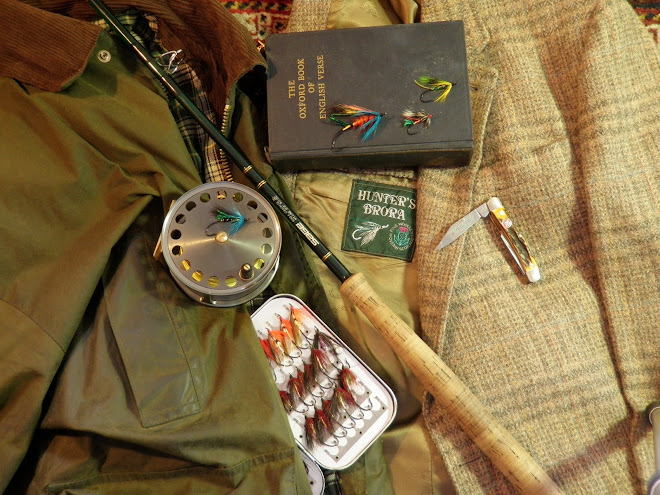
Bergman Plate of Dry Flies from 'Trout' and antique British rod with Hardy Bougle'.
 
Author’s note:
The following piece is a tongue in cheek approach to our human foibles and fly-fishing. Ernest Schwiebert wrote the bible on trout stream entomology and fly patterns, Matching the Hatch, and Nymphs, which contain great illustrations by the author, tales about fishing the bugs in storied places, and as scientific a study of Mayflies, Stoneflies, Caddis, etc. that ever has been undertaken in our sport. However, I have meet anglers on my journeys that were literalists, and like biblical literalists, often took things to a less than rational end. As many bugs as there are in nature, do we need every one in our fly box?

I had spent the last days of melting snow seated surrounded by books on the couch, and engrossing myself in the historic writings of the sages of fly-fishing upon aquatic insects, hatches, and flies to imitate them. Halford poked out from under a pillow. Skues resided lower down on the floor, where his nymphs plied the depths above the weeds of empty coffee mugs. Perched on the table were Flick and Gordon. Schwiebert rested neatly next to an ionic column candleholder higher than the rest. Swisher and Richards propped up each end of a stack of dirty dishes. Strewn over the lot were the efforts of the past weeks: nymphs and dry flies of all variety of styles, sizes and materials. This trout opener would not find me unprepared for any possibility.

Several weeks later all the lore and knowledge gleaned from those books stored in my cluttered brain, and my stream bag full to the breaking with the carefully crafted bits of entomological fur and feathers further to tempt the trout, I found myself on the banks of my favorite local stream. I sat and watched as several small brown trout ate some bugs in the riffles above me. I caught one of the tiny insects in hand, and muttered importantly to myself with a new air of wisdom, “Paraleptophlebia size 16 mahogany dun.”

I sorted through my boxes, now carefully labeled and arranged, and located one of the new exquisitely tied upright winged duns I had recently completed. I attached it to my tippet and crouching low, approached within casting range of the riffle and let out a long loop of line with an aerial mend, the fly dropping onto the water above the hungry fish and tantalizingly bouncing down to the waiting trout while riding high on the current. The first fish rose to look at the fly, and then calmly turned up its nose at the offending entrée, and ate a real bug. The next half-hour saw me change my fly down to a size 18, and then to a comparadun version, and then to an emerger, all without interesting a single fish. I caught another natural fly, and compared it to my imitations. If the famous Schwiebert himself had drawn and tied these flies, they could not have been a more exact simulacrum, down to the gray wings, precisely colored and ribbed body, and three tails. I could barely tell the difference until the real one flew off in a hurry to join its brothers and sisters and left me muttering imprecations.

I proceeded up the stream and around the next bend to see if the fish here would be a little more accommodating, but met with the same fate. One trout about a foot long swam over after eating one of the dainty mayflies and casually looked at me from underwater as if to say, “Give it up mister, we aren’t having any.”

Then I heard a splash and chuckle. A man was standing in the next pool and playing a fish. He was dressed in an old Elmer Fudd hat and wore a dilapidated mackinaw jacket. He was using an old sawed off hockey stick as a wading staff. As I watched, he released a nice trout and immediately hooked another one.

“Nice fish,” I called out. “What fly are you using?”
“Usin a brown one mister,” he replied. “Them trout are eating little brown bugs, so I use one of them brown flies to catch ‘em.”

He showed me the fly he had caught the fish on, and I was amazed and appalled all in the same glance. Here was some grievous sin against all those aforementioned great authors and fishermen whose writings and detailed studies of trout-stream entomology and fly-tying had haunted my slumbers these past weeks and months. It seemed to be tied on some old bait or worm hook. For a body it used an old brown rag, and the wing and hackle were twisted out of some giant brown chicken feather. It looked like something my neighbor’s dog spewed up on my doormat a few years ago after eating a dead pigeon and having a go at a heap of coffee grounds in the garbage can for an aperitif. The proportions were so far off, and the hook so much bigger than it should have been, that it seemed a parody to call it a fly. Then the old Elmer Fudd clone whisked his bent fly rod forward and the fly landed and disappeared in the swirl of another hungry trout. I went back to the car where I kept an emergency bottle of bourbon, and attempted save what I could of my own sanity.

Matching our little concoctions of fur and feather known as ‘flies’ to what the trout are feeding on is a great and important part of the game of fly-fishing. An elementary knowledge is necessary at least if one is to have any chance of fooling a wily fish with a morsel of food that instead has a sharp surprise hidden in plain view. When Mr. Trout wants a certain bug, he wants that bug only… or the theory goes… If he orders a grilled tuna sandwich with basil, feta cheese and dill mustard, and he instead receives a hamburger, nine times out of ten he will dismiss the offending sandwich in preference for his original order. In the remaining instance, he will eat the tablecloth, the hamburger and the waiter. There are times he may be so finicky that he will refuse every morsel of food not to his liking. Wrong size, wrong color, and wrong species… or right everything, but take it back to the kitchen anyway just to be irritating. This gourmet and selective feeding tendency has led to the study of fly-fishing entomology. Dozens of excellent books have been written on the subject, and if the reader ever has a case of intense curiosity or a need to cure insomnia, I suggest reading a few. One will learn in detail all the Latin names of the insects, their preferred dwelling places, their size, their life cycle with pictures and drawings of each of these, their color, their behavior, time of hatching (season – month – etc.) preferred time of emergence, sexual habits ( Hendricksons prefer blondes), and everything else one can read with interest and then forget or get helplessly muddled when on the water.

This entomological knowledge leads to a greater and more intimate understanding of the relationship between trout and their food, or just to more fish for the enlightened angler. At least in theory, because if we dare take the full-monty of fly patterns necessary to match the hatch on any stream in a given season, our poor brother of the angle would spend all his time seated on a rock by the stream sorting and indexing his flies and never wet his line. This is also known to the wise men of the English chalk streams as ‘Sporting Restraint.’

Our angling friend sees the fish feeding on the surface wildly and consistently one late August morning and, according to his acquired knowledge, (not his eyes) he postulates that the fish are feeding on tiny Tricos or Tricorythodes for those partial to the Roman vernacular. However, if we take this to its illogical conclusion by following these guides to the letter, we would need to identify if the bugs are Tricorythodes peridius, T. stygiatus. T. texanus, T. albilineatus, T. allectus, T. atratus, T. explicatus, T. fallax, T. fictus, T. minutus or possibly even… could it be… Tricorythodes absurdium?

In the long run it really doesn’t matter because any size 22 to 24 blackish sparse spinner pattern would mimic most all of these, and most importantly, as we remind ourselves after noting we are due for a visit to the ophthalmologist soon, we can’t see the tiny bloody things anyway.

I once knew a fine gentleman who tied up a couple of dozen of each of these flies in the nymph, dun and spinner stage. He waded into the water with his thousand flies and sinking into the muck on the bottom of the stream, was never heard from again. We miss him, but his hat, stuck on the bottom of the stream now marks a fine pool of trout.

Knowing the taxonomy of the bugs in general is certainly helpful, but when taken to extremes can become annoying, like the gathering in the back of the hall where the old fishing club holds its meetings, and when on any given evening after a meeting and a pint or three of beer may be heard more bad Latin then a prep school symposium on the translations of Caesar.
If you find yourself inserting ‘Ephemerella Subvaria’ into every other sentence as an affectation in order to seem wise while using a bad fake British accent, then you may become the guy at your company holiday party standing in the corner alone next to the potted plant and holding an empty glass.

We inherently want to know the reasons things happen. That oh-so-human character that leads us to study natural phenomenon and attempt to explain it. It is the character of curiosity that makes us human, brilliant, and flawed all at the same time. For always are we convinced that our new theory is the correct one. We propound that the sun revolves around the earth, various mythical beings created us and rule over our lives, that bad smells cause common diseases, and the best cure for that is by bleeding, personality and character is easily read by feeling the shape of the skull, bodily humors, etc. Certainly that is enough to make us shyly wince at our latest attempted explanation of why a trout likes Elmer’s fly and not ours. Wanting to know, however, has lead us to Gordon and Marinaro… to the great Catskill flies, and to the thorax variations. Wanting to know led anglers like Gary LaFontaine to don scuba equipment and discover that caddis emit gas bubbles that glimmer as the bug ascends, and many other discoveries and innovations that make our little sins committed on the stream so much more successful.

But… however scientific or grand our discoveries that lead to better bits of fur and feather, there is still the mind of the trout to contend with. To get to know the trout, we must get to think like him, and once in awhile after a particularly long day in our waders, even to smell like him too.
Perhaps feeding trout are like people ordering pizza. From across the room we know that they are eating pizza, but what kind? Is it a dun-variant pepperoni, or a spent-wing spinach and pineapple deep dish? There are so many crust and topping variations that the mind boggles at the possibilities. We can only make educated guesses by observation. Don’t take that to extremes either, or you might be like the guy who tasted some Blue Wing Olive mayflies to see why the trout liked them so much. I hear they went nicely with a light chardonnay.

Why trout refuse one fly and eat another that is better to their liking for some unseen reason might be explained by a guy watching the local football match on T.V. while drinking beers and eating a bowl of chips. He keeps subconsciously reaching for the chips and crunching them into his mouth again and again with about as much thought as capable in a trout brain the size of a pea, but when he accidentally reaches a bit too far and gets into the bowl of milk duds his wife placed there before Christmas, he hastily rejects the offending round ball out of instinct, and belching loudly, reaches for another beer instead.

Perhaps sometimes it might be O.K. not to know.
Sometimes the best thing to do might be to put our fly in the water…

Four anglers go fishing on a trout stream. One is a Catholic priest, one a philosopher, one a physicist, and the other the village idiot.
The priest walks on the water and asks the lord to choose him the right fly. He has absolute faith in the resulting choice.
The philosopher sits down on the bank and begins to contemplate the epistemology of bug knowledge.
The physicist starts examining and measuring the speed of the current, the roundness of the rocks, and the specific gravity of the water.
The village idiot puts on a fly and casts it into the water. In ten minutes he has limited out, and is back at his hovel cleaning the fish and stoking the fire to cook his dinner.

A silly little parable until we realize the poignant fact. The village idiot was the only one to actually place his fly in the water! As I tell beginning anglers, Pick a fly appropriate to the fish and conditions, tie it onto your leader, have confidence, and put it into the water. Those thousand flies in your boxes can never catch a fish, only the one in the water can.

That is not to say that an intimate knowledge of trout stream hatches and life cycles is not important, it is just that it is only one element of the game. Presentation and reading water being equally important among others. Your fly may be a perfect imitation of the bugs on the menu at the Cordon Bleu trout stream, but we also have to get them to the trout. I don’t know any epicurians of my acquaintance that show up to dine at the Ritz, and just read the menu.

Speaking of menus…
One thing stands out among the fly boxes of some of the best trout anglers I have ever had the pleasure to wet a line with. They use general patterns and a few more specific ones. General patterns match a number of insects of the same species… like the Adams, Gray Fox Variant or Hare’s Ear. One fly can manage a hatch of a size to either side of the imitation, and when this doesn’t work, then out come the specialty flies. When the trout are feeding and finicky, then we have to get fussy too.
Bob Blumreich, one of Wisconsin’s trout sages says (my paraphrase) “Flies should be suggestive of the real bug, but not exact. Exact imitations often don’t work as well as something that is the right color and the right size, but suggests the bug to a trout brain.”

Look at Al Troth’s superb pattern, the Elk Hair Caddis. Does it look like a caddis? Not unless we have a severe eye disorder or drank way too much scotch, but it does SUGGEST the size and shape of the bug with its tailless and tent-winged profile.

There are instances where one needs to carry a file cabinet of flies to be prepared. Still-water fisheries and spring creek trout are notoriously fussy, and often have a buffet of tasty morsels available to them. When this happens it might also help to have a psychiatrist as a fishing partner. The fish can be on emergers first and then switch to the duns, and then ignore both for something you can’t see. Meanwhile the largest spinner fall you have ever seen is occurring and the trout don’t care.

Since the preponderance of water I fish for trout are spring creeks, I tend to carry a lot of flies with me. I used to use a vest, but got tired of constantly having to rummage in the pockets, and decided to utilize a stream bag instead. Then I reorganized all my flies by species and purchased several more boxes to store them in. As a result, I was both more organized and disorganized at the same time. Instead of rummaging around in pockets for boxes, I now rooted around in my shoulder bag for them, usually dropping a few on the ground from time to time. The bag was heavy too, causing my shoulder to hurt and slump, so I moved the strap to the other shoulder, causing that one to slump equally as bad.

Back on the stream, you fumble with your flybox while extracting a pattern and dump the whole shebang into the river, following it downstream with loud splashing and many cries of dismay, while every one of the artificial flies gets ingested by a trout smacking its lips for more. Your buddy asks from downstream which box you dropped. “Caddis box,” you answer, and then watch with horror and fascination as he ties on a caddis and collects all your flies one by one by hooking the very fish that just chowed down on your chum smorgasbord, and after carefully removing your flies from their lips, hands them back to you with a wink. This is called in better-educated circles “Matching the Catch.”

Maybe old Elmer knew something after all…
Maybe sometimes less can be more…

Funny, but if you contrast the approach of great authors and anglers such as Art Flick and Ernest Schwiebert, one may view the two great schools of thought, those of general suggestive flies, and of perfect imitations. Thankfully, this sport is big enough to allow for both. If the minor studies in entomology cause both clarification and obfuscation at the same time, we may remind ourselves that making things far more complicated than necessary for most people in the spirit and intent of explanation is one of the great aspects of this little hobby of ours. For some of us, knowing the Latin name of the bug, its sex, and exact size and color might add something to the game we play with the trout, and others of us might not care at all, preferring to fish a little olive bug when that is what the fish are eating.

So next time you run across someone sitting on the bank deep into study of a copy of the epic seven volume tome “Naturalis Insectora Stupendium,” and searching through his ten drawer chest fly box, you might want to have a few brown rag flies handy to give him. You may be doing him a favor.